The long-awaited judgment of the CJEU in Mio/Konektra was delivered on December 4, 2025. It constitutes an important addition to a series of CJEU judgments centered on the copyright protection of works of applied art. As Advocate General Szpunar writes, these cases illustrate the dilemmas that arise with objects that exist at the boundary between ‘pure’ works of art and ordinary utilitarian objects. The question of copyright protection for applied art is answered differently across various legal systems, ranging from exclusion to full protection. What these systems do have in common is dissatisfaction with their functioning due to the lack of clear demarcation and the resulting unpredictability and legal uncertainty. Does the CJEU finally provide clarity?
Parties and objects
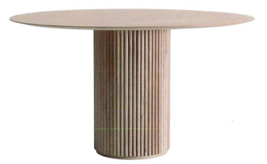
The case Mio (C-580/23) concerns a dispute between two Swedish furniture manufacturers, in which Asplund claims that Mio’s “Cord” table infringes the copyright in Asplund’s “Palais Royal” table. In Konektra (C-795/23), the modular furniture system marketed by the Swiss company USM under the name “USM Haller” is central. The German company Konektra sells online components compatible with the USM Haller system. But Konektra no longer only offers replacement parts — it manufactures and sells its own furniture system, which USM claims is identical to its own and therefore infringes its copyright.
Images of both claimants’ products are shown below.

The national courts decided to refer preliminary questions to the CJEU, which, given the substantial overlap between the questions, decided to join the cases.
Discussion of the preliminary questions
Relationship between copyright and design protection
The first question raised by the national courts concerns the core of the relationship between copyright and design law, and how these relate to each other in the protection of works of applied art. They ask whether a rule-exception relationship exists between design protection and copyright protection. A passage in the earlier Cofemel judgment of the CJEU has apparently caused confusion as to whether a hierarchical relationship exists between the two protection regimes, where copyright protection might be more difficult to obtain for applied art than design protection. In Cofemel, the Court stated that “design protection and copyright protection under Union law may indeed be granted cumulatively to the same object, but such cumulative protection can only be envisaged in certain situations.”
In his opinion, AG Szpunar rejects the interpretation that a higher threshold of originality applies to works of applied art. According to him, the passage from Cofemel is a warning from the CJEU to national courts that no automatic link exists between the granting of design protection and copyright protection, and that the criteria for these protections must not be confused. Copyright applies a “subjective criterion of protection,” focused on the author’s personality as expressed in the work, whereas design law applies an “objective criterion of protection,” namely novelty and individual character.
The Court follows its Advocate General and provides additional clarification of the passage from Cofemel. The decisive factor for copyright protection remains whether the object reflects the personality of the author by expressing their free and creative choices. The “restriction” in Cofemel regarding copyright protection for “certain situations” does not refer to a higher threshold, but rather to maintaining a strict separation between the two protection regimes.
The Court stresses: model-protected objects are in principle “not comparable” to objects protected by copyright, and no automatic connection exists between the two. In design protection, the focus is on the objective overall visual impression that distinguishes itself from existing designs, whereas in copyright protection the subjective personality of the creator is central. Cumulative protection is therefore only possible when an object not only has a distinctive visual appearance, but also genuinely reflects the creator’s personality.
Some confusion arises when the Court adds to these considerations that such cumulative protection remains limited to certain cases, “since an author must create a unique work that reflects his personality.” The term “unique” may evoke stronger associations with the objective criteria of design law than with the subjective criteria of copyright law. However, the prevailing message of the judgment remains that copyright protection depends on the subjective connection between the creator and their work, not on the objective distinctiveness of the work compared to other works.
Originality in applied art
The second question concerns how the originality criterion should be interpreted for works of applied art. On the one hand, the national courts ask whether the assessment should focus on factors related to the creative process and the intention of the creator, or on elements that are visible in the work itself. On the other hand, they ask whether additional factors play a role, such as the use of common design features, inspiration from existing objects, the possibility of independent creation of similar objects, or recognition within professional circles.
The Advocate General emphasizes in his opinion that the creative choices and the author’s personality must be visible in the object for which protection is claimed. Copyright does not protect ideas, only the concrete expressions of those ideas. According to the AG, the “intention of the author” belongs to the idea side and is therefore protected only to the extent that the author has expressed it in the work. The Court follows this reasoning.
The Court further considers, in line with its earlier case law, that a utilitarian object can be original — even if its realization is partly determined by technical considerations — provided that the maker was able to reflect their personality in it. The Court acknowledges, with reference to the AG’s opinion, the specific nature of works of applied art: primarily utility objects. This means, according to the Court, that (unlike in “pure art”) one cannot presume that the maker’s free choices (i.e., not dictated by technical constraints) are creative. To assess whether a utilitarian object is original, the national court must examine and identify the creative choices visible in the form of the object in order to classify it as a copyright-protected work.
The Court also draws an important distinction between aesthetic effects and originality. It warns that the fact that an object, aside from its utilitarian purpose, produces its own “striking visual effect” from an aesthetic or artistic standpoint is not sufficient to qualify it as a copyright-protected work. In other words, a design can be artistically appealing (and visually clearly distinct from other designs), but still not be original in the copyright sense if it does not express the personality of the creator.
As regards the other factors about which the national courts wondered what role they might play in the assessment of originality, the Court remains somewhat vague. It states that the national court must assess whether the object is copyright-protected on the basis of all relevant elements of the case as they existed at the time the object was designed, regardless of factors that arose after the creation of the object and independently of it. With respect to those additional factors, the Court finds that they may be taken into account where appropriate, but are in any event “neither necessary nor decisive” for determining the originality of the object.
Assessment of infringement
The final set of questions concerns the assessment of infringement in relation to works of applied art. First, the referring courts ask whether the assessment focuses on the recognisable appropriation of copyright-protected features, or whether the same overall visual impression is sufficient. Second, they ask whether the degree of originality of the work must be taken into account, and third, what role the existence of a similar object plays.
The Court recalls that the unauthorized use of a work (i.e., use without the author’s permission) can constitute an infringement, even when the use concerns a relatively small part of the protected work, if that part in itself expresses the author’s own intellectual creation. According to the Court, the national court must first determine that copyright-protected elements (elements that express the choices reflecting the personality of the creator) have been used without authorization, and whether these elements have been recognisably taken over in the allegedly infringing object.
The Court refers in this regard to its earlier Pelham judgment, which concerns the (un)recognisable sampling of a sound fragment. If the sound fragment, however short, is sampled in a recognisable way, there is an infringement. When it is no longer recognisable in the new work, the right holder cannot oppose its use.
In line with that, the Court considers that in assessing copyright infringement, the comparison of the overall impression of both objects cannot be decisive. That criterion belongs to design law, according to the Court. This appears to render the “overall-impression criterion” formulated by the Dutch Supreme Court obsolete. However, the question remains when the copyright-protected features have been recognisably taken over in the allegedly infringing object, and what role details play in that assessment.
According to the Court, the “degree of originality of the protected work” is also irrelevant in the assessment of infringement. The scope of protection of a work does not depend on the extent of the creator’s creative freedom. Once the object qualifies as a work, it has the same scope of protection as all other protected works.
Finally, the Court addresses the existence of an independently created similar object. The existence of an independent creation is a valid defence against infringement claims. After all, copyright only protects against unauthorized copying, not against someone else independently arriving at the same creation. The difficulty with works of applied art lies in the fact that the “creative freedom” in such works is more limited due to the technical and functional requirements that the object must meet. This increases the likelihood of similar creations without any copying.
According to the Court, when the defendant relies on this defence, the judge must assess whether there is indeed an independently created similar object. The burden of proof for this defence naturally lies with the defendant. Although the Court does not provide specific guidance on this, it could be demonstrated, for example, by submitting documentation of the design process. If the defendant succeeds in proving that there was an independent design process, there is no infringement, even if the objects are very similar. The existence of an independently created similar object only plays a role in assessing infringement, not in the evaluation of the originality of the protected work.
Conclusion
Although the Court provides clarity on certain points, a number of questions remain even after this judgment. Copyright law is no stranger to abstract concepts, and different interpretations of them will remain possible after this ruling. What is clear, in my view, is that claimants in the Netherlands will have their work cut out for them, now that the judgment makes explicit that not every free choice is also a creative one that reflects the author’s personality. In addition, Dutch courts will have to move toward a more detailed analysis of which specific creative elements have been taken over, rather than focusing on a comparison of overall impressions. The coming years will show how this judgment will be implemented in Dutch case law.